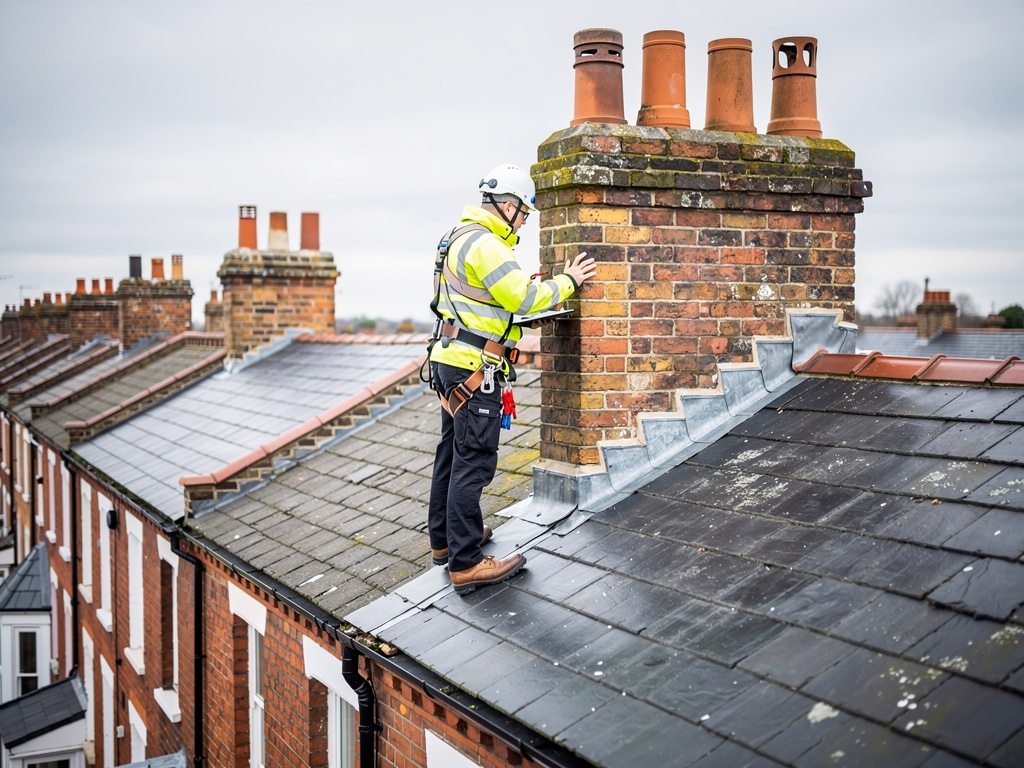
Ask any experienced roof surveyor in the UK what the single most common source of roof leaks is, and they'll give you the same answer: the chimney. Chimney stacks, lead flashings, and chimney caps are responsible for a disproportionate share of the water ingress problems we identify in properties across the country. They're exposed at the highest point of the roof, subject to extreme weather, and — particularly in homes where the chimney is no longer in active use — often invisible and forgotten until a stain appears on the bedroom ceiling.
Why Chimneys Cause So Many Problems in UK Properties
The chimney stack of a typical Victorian or Edwardian house is an impressive piece of masonry — a column of brick and mortar rising several metres above the ridge line of the roof, exposed to wind, rain, frost, and UV light every hour of every day. Unlike the main roof covering, which is largely horizontal and sheds water by gravity, the chimney stack presents four vertical faces to the elements, with multiple junctions, copings, pots, and flashing details at which water can find a way in.
The problem is compounded by the nature of the materials involved. Mortar joints in brickwork have a natural lifespan of 30–50 years before they begin to erode and require repointing. Lead flashings — the metal sheets that seal the junction between the chimney stack and the roof slope — can theoretically last 100 years or more, but they are vulnerable to thermal movement, physical damage, poor initial installation, and theft. Chimney pots and their mortar haunching can crack and become loose. And unused chimneys, if not properly capped off, become effectively hollow columns open to the sky, funnelling rainwater directly into the roof void.
The combined effect is that virtually every chimney in a pre-1980s UK property will require some level of remedial work at some point. The question for any homeowner is: has that work been done, and done properly?
What Does a Professional Chimney Inspection Cover?
At Roof Surveyor London, chimney inspection is an integral part of every roof survey we carry out. Rather than a cursory glance from ground level, we assess the chimney stack in as much detail as the access situation allows — using ladders, scaffolding, or drone photography where physical access is not practical.
Our chimney assessment covers the external masonry condition, including the state of mortar joints at all faces, any visible spalling or erosion of the bricks themselves, the condition of the chimney coping (the projecting course at the top of the stack that sheds rainwater away from the brickwork), and any visible cracking or structural movement. We examine the chimney pots and their mortar haunching, checking for loose pots, cracked haunching, and whether unused flues have been properly capped.
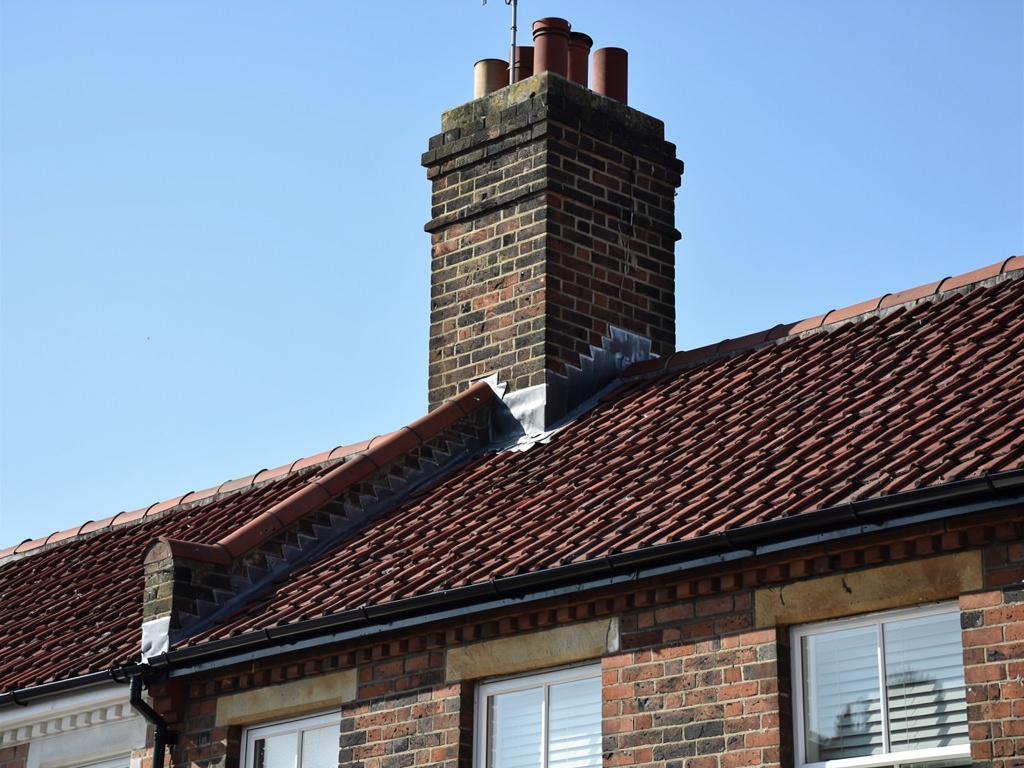
The lead or code-compliant flashing at the base of the chimney — where the stack meets the roof slope — receives particularly close attention. We examine the step flashings (the individual pieces that step up the side of the chimney alongside each roof course), the back gutter (the piece that collects water running off the back of the chimney), and the apron (the piece that sheds water from the front face of the chimney onto the roof slope). We check that soakers are correctly installed between the tiles or slates and the step flashings, and that all lead is secured and lapped correctly with no open joints.
The Most Common Chimney Defects We Find
Failed or Open Mortar Pointing
This is by far the most common chimney defect we encounter. As mortar joints age, they erode and open up, allowing water to penetrate the brickwork. In older properties, the original lime mortar may have been repointed at some point with harder cement mortar — a well-intentioned repair that actually accelerates deterioration, as the harder cement traps moisture in the softer bricks and causes them to spall. Correct repointing uses an appropriately soft mortar mix matched to the age and hardness of the existing brickwork.
Failed Lead Flashing
Lead flashing failure is the second most common chimney defect and arguably the most directly damaging. When flashing fails — whether through poor original installation, thermal movement cracking, lifting at the edges, or inadequate overlap — water runs down the junction between the chimney and the roof and directly into the roof void. The first sign inside the property is typically a watermark or damp patch on the ceiling of the highest bedroom, often initially blamed on condensation. By the time this is visible inside, the timber in the immediate vicinity has usually been wet for long enough to begin absorbing significant moisture.
Flashing repairs range from minor resealing of lifted edges or open joints (a modest cost if caught early) to full replacement of all lead flashings around the chimney stack (a more significant repair requiring scaffold access and a skilled plumber or specialist roofer). A survey identifies exactly what is needed and whether the existing lead is sound enough to repair or has deteriorated to the point where full replacement is the only durable solution.
Loose or Missing Chimney Pots
Chimney pots are set in mortar haunching at the top of the flue. Over decades, this mortar erodes, and pots can become loose — vulnerable to being displaced in high winds. A falling chimney pot is a significant safety hazard as well as a roofing problem. During the severe storms that regularly affect the UK each winter, displaced or falling chimney pots are responsible for substantial roof damage and, in worst cases, serious injury. We check every pot for security on every survey.
Uncapped Unused Flues
Millions of UK homes have chimney stacks with flues that are no longer in use. When fireplaces are removed or boilers are converted, the flues often remain open — either entirely uncapped or sealed only with a pot in deteriorating mortar. An open flue is a direct conduit for rainwater into the property. The water can travel down the inside of the flue liner, emerge into the fireplace recess (if it still exists), or seep through the chimney breast into adjacent rooms. Fitting a ventilated cap over an unused flue is a relatively straightforward and inexpensive repair — but it needs to be done.
What Do Chimney Repairs Typically Cost in the UK?
One of the most important things homeowners want to know after a survey is what the identified repairs will cost. Below are typical cost ranges for the most common chimney repairs in the UK. These are estimates — actual costs vary by region, access requirements, and the specific nature of the work. Your surveyor will help you understand what's involved in each case.
Chimney Repointing
Dependent on access (scaffold or ladder), size of stack, and extent of work needed. Includes rake out and repoint of all faces.
Lead Flashing Repair
For partial repairs to existing lead — resealing lifted sections, re-dressing, and re-securing flashings. Scaffold may be required.
Full Lead Flashing Replacement
For complete renewal of all flashings around the chimney stack. Cost increases with chimney width and access requirements.
Chimney Pot Re-haunching
Re-setting loose pots in new mortar. Includes scaffold or MEWP access and replacement of any damaged pots.
Flue Capping (unused flue)
Supply and fit of a ventilated cowl or capping plate to seal an unused flue against weather ingress while maintaining ventilation.
Full Chimney Stack Rebuild
For significantly deteriorated or structurally compromised stacks. Includes scaffold, demolition, rebuild in matching materials, and new flashing.
Don't Ignore a Chimney Problem
The temptation is to ignore a chimney that isn't in active use and hope it's not causing problems. In our experience, unused chimneys in poor condition cause more water ingress than active ones, because they're less likely to be maintained and more likely to have been inappropriately sealed at the base. If you have a chimney stack, it needs regular inspection — regardless of whether you use the fireplace.
Chimney Safety: Beyond Water Ingress
Water damage is the most common consequence of a deteriorating chimney, but it's not the only concern. Structurally compromised chimney stacks are a genuine safety risk. A chimney stack that has developed significant cracks, that leans noticeably, or whose brickwork has become unstable presents a risk of partial or complete collapse — particularly during storms. The consequences of a chimney collapse range from serious roof damage to catastrophic injury.
Our surveys assess the structural stability of every chimney stack we inspect, not just its waterproofing details. Where we identify structural concerns — significant leaning, major cracking, or badly deteriorated brickwork — we flag these as urgent and recommend immediate specialist assessment. In such cases, erecting temporary bracing or making the chimney safe before full repairs are carried out may be necessary.
For properties that are being bought or sold, the condition of chimney stacks is one of the areas most commonly identified as a concern in our surveys — and one of the most commonly used as grounds for price renegotiation. Chimney repairs are visible, quantifiable, and their cost is well established. A survey that identifies required chimney work gives a buyer concrete evidence to support a realistic price reduction.
How often should a chimney be inspected?
Can I inspect my own chimney without a professional?
My neighbour has a party wall chimney stack — whose responsibility is it?

Sarah has assessed hundreds of chimney stacks across the UK as part of her specialist roof surveys. She has particular expertise in Victorian and Edwardian period properties and is frequently asked to advise on chimney-related disputes between neighbours and between buyers and vendors.
Concerned About Your Chimney?
Book a specialist roof survey that includes a detailed chimney assessment. We'll tell you exactly what's happening and what needs to be done.
Related Articles: Surveying Victorian Roofs | Roof Leaks: Causes and Solutions | 10 Early Warning Signs